How Daylight Saving Transitions Reshape Peak Activity Windows for Virtual Table Sessions in Licensed Mobile Apps
Written by Kai Brooks · Jul 22, 2026
How Daylight Saving Transitions Reshape Peak Activity Windows for Virtual Table Sessions in Licensed Mobile Apps
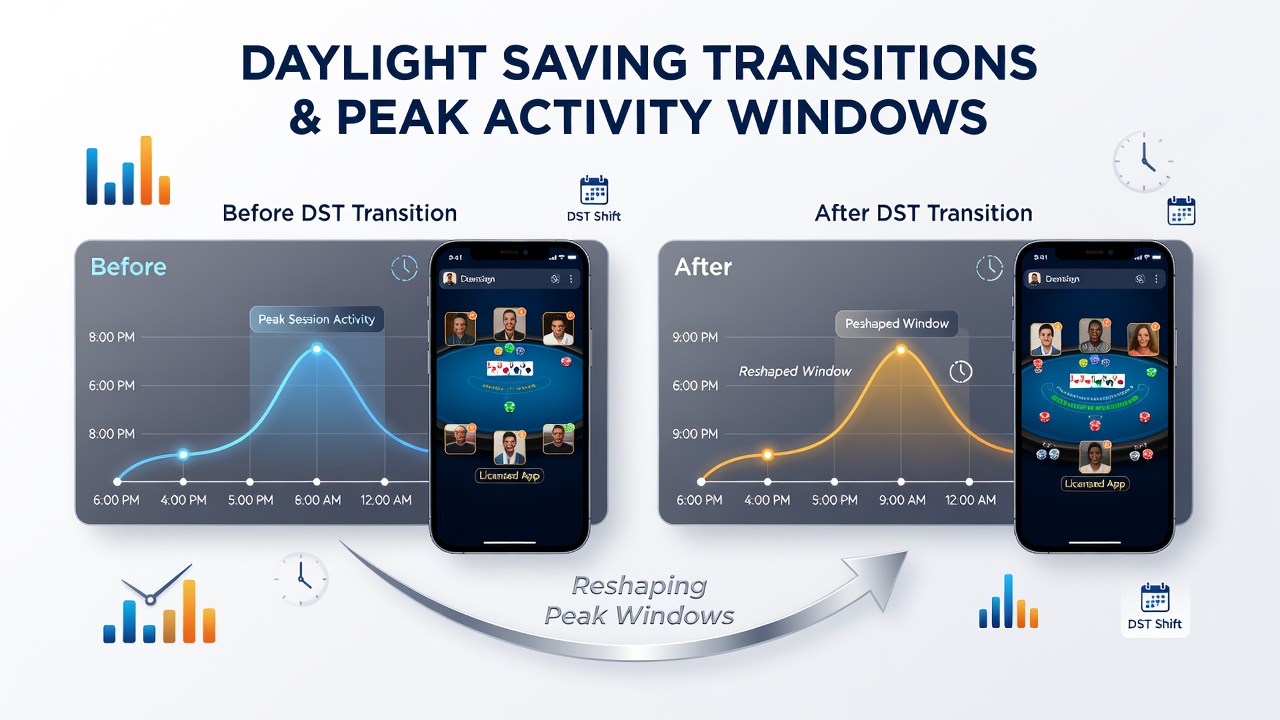
Data from multiple jurisdictions shows that daylight saving transitions create measurable shifts in user engagement patterns for virtual table sessions inside licensed mobile apps, and these changes appear most clearly in regions that observe clock adjustments twice each year. Researchers tracking app telemetry across North America and parts of Europe have documented how the spring forward and fall back events move peak login windows by thirty to ninety minutes within forty-eight hours of each change. Licensed operators report that live dealer tables and scheduled virtual sessions experience the clearest redistribution of traffic because those products tie directly to real-time human staffing schedules that follow local clock time rather than UTC.
Mechanics of Clock Changes and App Engagement
Daylight saving adjustments alter the alignment between solar time and social schedules, which in turn affects when people open mobile devices for extended interactive sessions. In jurisdictions such as most Canadian provinces and several Australian states, operators have recorded a compression of evening activity clusters immediately after the spring transition, while the autumn reversion tends to stretch the same windows later into the night. Platform analytics indicate that users who previously joined virtual tables between 7:00 p.m. and 10:00 p.m. local time often migrate to 8:00 p.m. through 11:00 p.m. slots during the first week after clocks move forward. These patterns emerge because daily routines tied to work start times, school schedules, and meal periods remain anchored to the new clock setting even though internal circadian rhythms adjust more slowly.
Regional Variations Across Licensed Markets
States and provinces maintain different approaches to daylight saving observance, creating natural experiments for operators who run multi-jurisdictional apps. Arizona and Hawaii remain on standard time year-round, whereas neighboring jurisdictions shift, and the resulting time-zone boundary effects appear in cross-border user data. A 2025 study commissioned by the Canadian Gaming Association found that Ontario-licensed apps saw a 14 percent increase in table-session starts between 9:00 p.m. and midnight local time during the week following the March transition, while apps serving British Columbia users showed a smaller 7 percent shift because the province borders a non-observing region. Similar boundary effects have been noted along the New South Wales–Queensland border in Australia, where only one side adjusts clocks. Operators therefore adjust live-dealer shift schedules and automated table-opening algorithms to match the new local peaks rather than relying on fixed UTC-based staffing models.
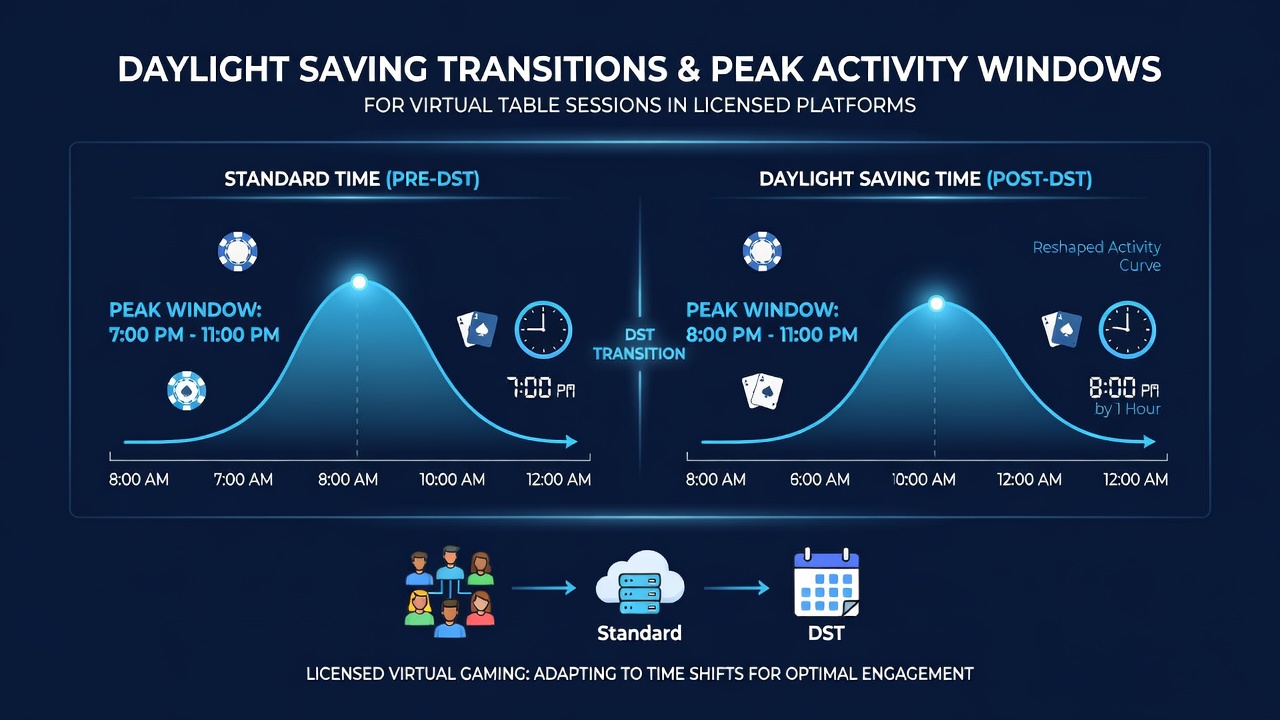
Telemetry collected by platform providers reveals that push-notification response rates also move in tandem with the clock changes. Users who receive session-start reminders calibrated to pre-transition peak hours show lower immediate open rates for the first three days after the change, after which engagement stabilizes at the new window. Licensed apps in regulated markets must therefore update notification schedules within the first twenty-four hours to maintain comparable retention metrics, and several large operators have automated this process using historical transition data from the previous two years.
Operational Adjustments by Licensed Operators
Live table staffing represents the largest fixed cost tied to these shifts, because dealers and floor supervisors work according to local clock time. In July 2026, several major operators published updated shift-planning guidelines that incorporate a sixty-minute buffer on either side of predicted peak windows during the first week after each transition. These guidelines draw on aggregated anonymized session data submitted to regulatory bodies in New Jersey, Pennsylvania, and Michigan, which require quarterly reporting of time-stamped activity metrics. The resulting staffing models reduce overstaffing during the lag period and prevent understaffing when users migrate later into the evening. Automated table-management systems inside the apps simultaneously adjust minimum and maximum player thresholds to match the redistributed demand, keeping session availability aligned with actual concurrent users.
Data Sources and Measurement Approaches
Independent research groups have begun incorporating daylight-saving variables into broader studies of digital wagering behavior. A report released by the Alberta Gaming Research Institute in early 2026 examined twelve months of session logs from three licensed operators and isolated the effect of clock changes from other seasonal factors such as holidays and sports calendars. The analysis showed that the redistribution of table activity accounts for roughly 2.3 percent of total monthly variation in login timestamps, a figure large enough to influence revenue-forecasting models used by finance teams. Regulatory filings from the same period confirm that operators who pre-adjust notification and staffing schedules experience smaller deviations from projected handle during transition weeks compared with those that do not.
Network-level data from mobile carriers adds another layer of confirmation. Time-stamped connection logs indicate that overall mobile data usage for gaming-category apps spikes later in the evening immediately after the spring transition and returns toward baseline within ten days. This pattern holds across both iOS and Android devices, although the magnitude differs slightly by operating system because of variations in background-refresh policies. Operators monitoring carrier data alongside their own telemetry obtain earlier signals of the shift and can fine-tune table availability before the weekend following each change.
Conclusion
Daylight saving transitions produce consistent, measurable displacements in the timing of virtual table sessions within licensed mobile apps, and operators that track these movements through telemetry and regulatory reporting adjust staffing, notifications, and table parameters accordingly. The effect appears across multiple jurisdictions that observe clock changes, with boundary regions between observing and non-observing areas showing the most pronounced cross-time-zone influences. Data collected through 2026 continues to support the same directional patterns first identified in earlier transition cycles, confirming that the phenomenon remains a stable factor in operational planning for real-time table products.